India’s Central Pay Commissions (CPCs) have been instrumental in shaping the salary, pension, and allowance structures of central government employees. Since independence, eight Pay Commissions have been constituted, each responding to the prevailing economic conditions, inflation, and employee welfare needs. The recommendations of these commissions not only impact more than 30 lakh central government employees and pensioners but also influence state governments and public sector undertakings.
With the 8th Pay Commission (8th CPC) approved in January 2025 and expected to be implemented from January 2026, understanding the history of previous Pay Commissions becomes essential. In this blog, we present a detailed list of all Pay Commissions in India, their implementation years, key members, and their major recommendations.
What is a Pay Commission?
A Pay Commission is a government-appointed body that reviews and recommends changes to the salary, allowances, and pension structures of central government employees. It typically considers factors like inflation, cost of living, economic growth, and government finances. Once the recommendations are submitted, the government decides on their acceptance and implementation.
Also read: Central Government Employee Retirement Benefits in India: Pension, Gratuity & Perks Explained
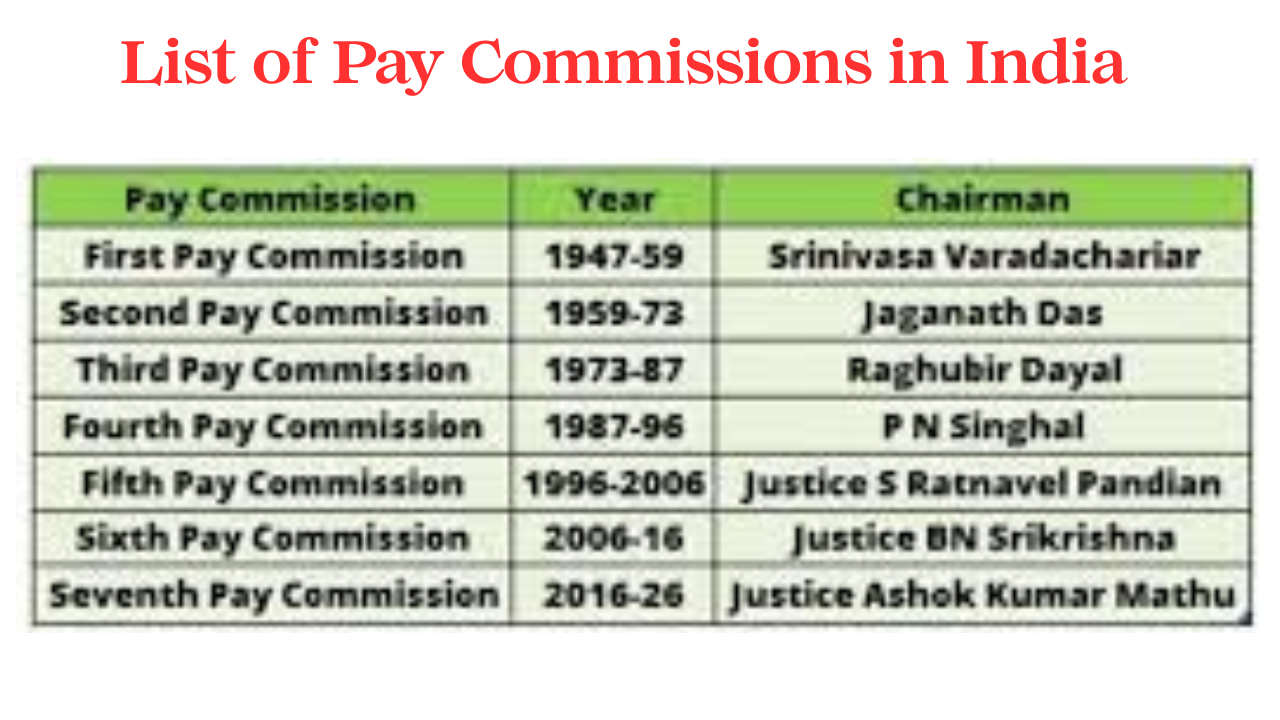
List of Pay Commissions in India
1. First Central Pay Commission (1st CPC)
- Formation Year: 1956
- Implementation Year: January 1, 1957
- Chairman: Raghubir Singh
- Key Recommendations:
- Introduced a simplified pay scale system.
- Addressed the need for a uniform structure for different categories of government employees.
- Introduced a simplified pay scale system.
The First CPC laid the foundation for structured pay and allowances in independent India.
2. Second Central Pay Commission (2nd CPC)
- Formation Year: 1970
- Implementation Year: January 1, 1973
- Chairman: R. S. Ghosh
- Key Recommendations:
- Introduced revised pay scales to reduce disparities.
- Brought in rationalization in salaries to match inflation and the economic scenario.
- Introduced revised pay scales to reduce disparities.
The 2nd CPC was crucial in addressing the widening income gaps among employees.
3. Third Central Pay Commission (3rd CPC)
- Formation Year: 1979
- Implementation Year: January 1, 1986
- Chairman: J. M. M. Sinha
- Key Recommendations:
- Adopted a systematic approach to pay scales.
- Brought clarity in pay fixation and allowances.
- Adopted a systematic approach to pay scales.
This commission worked on reducing complexities in salary structures.
4. Fourth Central Pay Commission (4th CPC)
- Formation Year: 1986
- Implementation Year: January 1, 1986
- Chairman: R. S. Ghosh
- Key Recommendations:
- Suggested major changes in pay and allowances.
- Improved compensation to keep pace with the rising cost of living.
- Suggested major changes in pay and allowances.
The 4th CPC brought significant reforms in allowances and salary structures.
5. Fifth Central Pay Commission (5th CPC)
- Formation Year: April 1994
- Implementation Year: January 1, 1996
- Chairman: Justice S. Ratnavel Pandian
- Key Recommendations:
- Reduced the number of pay scales from 51 to 34.
Minimum salary was significantly increased.
- Recommended better pension structures.
- Reduced the number of pay scales from 51 to 34.
The 5th CPC was among the most impactful, leading to higher employee morale.
6. Sixth Central Pay Commission (6th CPC)
- Formation Year: July 2006
- Implementation Year: January 1, 2006
- Chairman: Justice B.N. Srikrishna
- Key Recommendations:
- Introduced running pay bands with grade pay.
Increased the minimum basic salary to ₹7,000.
- Streamlined allowances and introduced new pay structures.
- Introduced running pay bands with grade pay.
The 6th CPC modernized the salary framework and introduced new concepts like grade pay.
7. Seventh Central Pay Commission (7th CPC)
- Formation Year: February 2014
- Implementation Year: January 1, 2016
- Chairman: A. K. Mathur
- Key Recommendations:
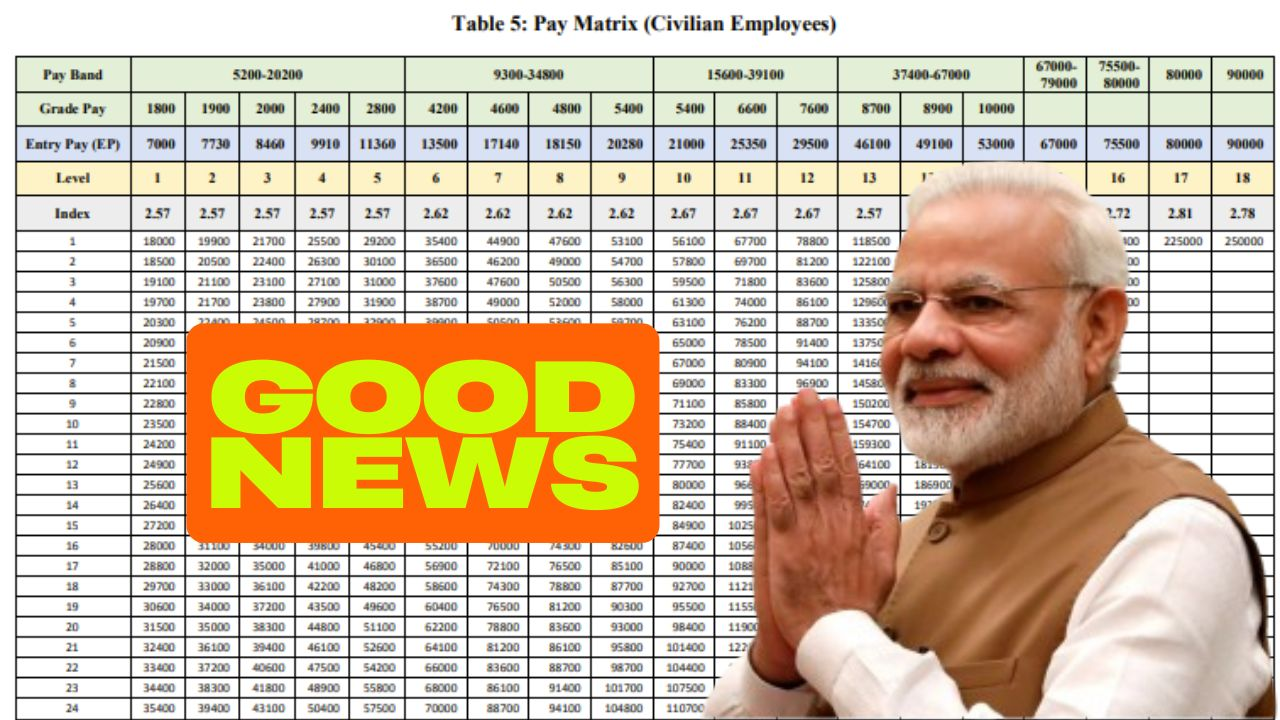
- Increased minimum pay to ₹18,000 per month.
Introduced a fitment factor of 2.57.
Revised allowances like HRA, DA, and transport allowance.
- Pensioners received substantial benefits.
- Increased minimum pay to ₹18,000 per month.
The 7th CPC was designed to address inflation and modern workforce demands, directly impacting millions of employees and retirees.
8. Eighth Central Pay Commission (8th CPC)
- Formation Year: January 2025
- Expected Implementation: January 2026
- Key Members: To be appointed soon.
- Key Highlights (Expected):
- Likely to recommend a fitment factor of 3.68.
Significant increase in salaries and pensions expected.
- Revised DA, HRA, and medical allowances to match economic conditions.
- Likely to recommend a fitment factor of 3.68.
Approved by Prime Minister Narendra Modi in January 2025, the 8th CPC is expected to address employee welfare while balancing fiscal responsibility.
Importance of Pay Commissions
The evolution of Pay Commissions highlights India’s commitment to ensuring fair compensation for its government employees. Their recommendations:
- Help adjust salaries with inflation.
- Ensure equity across employee levels.
- Motivate employees with better pay and pension benefits.
- Balance public expenditure and employee welfare.
Each commission builds upon the last, ensuring that employee benefits remain relevant in a changing economic environment.
Conclusion
The history of Pay Commissions in India reflects how the government adapts compensation structures in response to economic shifts and employee welfare needs. From the 1st CPC in 1957 to the upcoming 8th CPC in 2026, every commission has played a pivotal role in shaping the livelihood of central government employees and pensioners. As the 8th Pay Commission nears implementation, government employees are eagerly awaiting details of salary hikes, allowances, and pension reforms. This upcoming commission is expected to significantly improve the financial security of millions of workers and retirees, marking another milestone in India’s administrative and economic reforms.
FAQs
1. What is a Pay Commission in India?
A Pay Commission is a government-appointed body that reviews and recommends changes to salaries, allowances, and pensions of central government employees.
2. How many Pay Commissions have been formed in India so far?
India has had 8 Pay Commissions so far, from the 1st CPC in 1957 to the 8th CPC, approved in 2025 and expected to be implemented from 2026.
3. What is the purpose of the 8th Pay Commission?
The 8th CPC aims to revise salaries, allowances, pensions, and other benefits for central government employees and pensioners, taking into account inflation and economic growth.
4. What is a fitment factor in Pay Commissions?
The fitment factor is a multiplier used to calculate the revised salary of government employees from the previous CPC’s pay structure. For example, the 7th CPC used a fitment factor of 2.57.
5. What was the minimum salary under the 7th Pay Commission?
Under the 7th CPC, the minimum basic salary for central government employees was ₹18,000 per month.
6. When will the 8th Pay Commission be implemented?
The 8th Pay Commission has been approved in January 2025 and is expected to be implemented from January 2026.
7. Who decides the recommendations of a Pay Commission?
The recommendations are submitted to the Government of India, which reviews and decides the extent of implementation for employees, allowances, and pensions.
8. How do Pay Commissions affect pensions?
Pay Commissions revise pensions using the fitment factor, ensuring parity between serving employees and pensioners, along with revisions to gratuity and other retirement benefits.
9. What are the key allowances revised by Pay Commissions?
Key allowances include House Rent Allowance (HRA), Transport Allowance, Dearness Allowance (DA), Military Service Pay (MSP), and other special allowances for defence personnel.
10. How do Pay Commissions impact state governments and PSUs?
Although CPCs directly affect central government employees, their recommendations often influence salary structures and allowances for state government employees and public sector undertakings (PSUs).