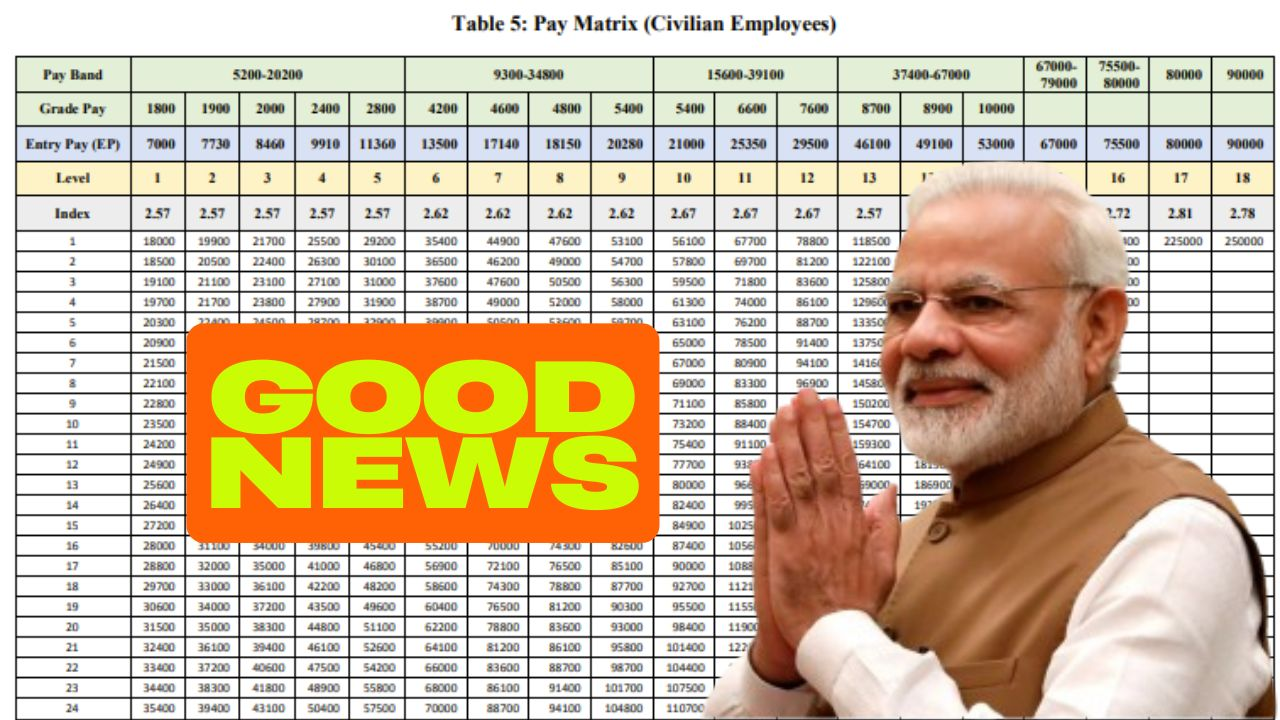
Good news for over 50 lakh central government employees and 69 lakh pensioners — the long-awaited 8th Pay Commission is on the way. The central government has approved the terms and conditions for setting up the commission, marking a significant step towards revising salaries, allowances, and pensions.
According to reports, the commission’s recommendations are expected to be finalized within 18 months, and the new pay structure could come into effect from 1st January 2026. This move will directly impact the financial well-being of millions of employees and retirees across India.
8th Pay Commission Latest News and Implementation Timeline
As per the latest updates, the Government of India has officially approved the terms and conditions for the 8th Pay Commission, marking a major step toward implementation.
The commission’s recommendations are expected to be submitted within 18 months, with the new pay structure effective from January 1, 2026. The payment of revised salaries and arrears may continue until the end of 2027, as the process involves several departments and financial adjustments.
The announcement of commission members and formal meetings are expected soon, with a focus on rationalizing pay, pensions, and allowances for over 1.2 crore employees and pensioners combined.
The decision has been welcomed by unions and employees across central and state governments, as it promises long-awaited financial relief and modernization of pay systems.
Also read: Provident Fund: Definition, Benefits, and How to Withdraw PF Online
Objectives of the 8th Pay Commission
The primary purpose of the 8th Pay Commission is to review and recommend fair compensation and allowances for government employees in line with inflation, cost of living, and economic growth.
The commission will assess the following factors:
- Pay Structure Revision – To ensure that government employees receive salaries comparable to their private-sector counterparts.
- Allowances and Benefits – To rationalize allowances like HRA, DA, TA, etc., ensuring uniformity and fairness.
- Pension Reforms – To review pension structures and ensure financial stability for retired employees.
- Performance-Based Pay – Introduction of mechanisms linking performance and productivity to pay increments.
Key Highlights of the 8th Pay Commission Proposal
- Implementation Date:
The new pay scales will likely be implemented from January 1, 2026. - Report Submission:
Recommendations to be finalized within 18 months after the commission’s formation. - Salary Revision:
Expected salary hike of 25–35%, depending on grades and current pay levels. - Fitment Factor:
Proposed to increase from 2.57 (7th CPC) to around 3.00 or higher, which will directly affect the basic pay. - DA Merger:
The Dearness Allowance (DA) will be merged with the basic pay before applying the new pay matrix.
Expected Salary and Fitment Factor Comparison
Here’s a comparative overview of pay structure changes across the 6th, 7th, and expected 8th Pay Commissions:
| Pay Commission | Implementation Date | Minimum Basic Pay | Fitment Factor | Expected Salary Hike | Average DA Before Merger |
|---|---|---|---|---|---|
| 6th Pay Commission | 1 Jan 2006 | ₹7,000 | 1.86 | 40% | 22% (2005) |
| 7th Pay Commission | 1 Jan 2016 | ₹18,000 | 2.57 | 14–20% | 125% (2015) |
| 8th Pay Commission* | 1 Jan 2026 (expected) | ₹41,000–₹51,480 | 2.86–3.00 (approx.) | 25–35% | 52% (2024 expected) |
*Estimated figures based on economic projections and past commission patterns.
8th Pay Commission Salary Calculator
Employees can estimate their new basic pay under the 8th Pay Commission using a simple calculation formula based on the proposed fitment factor:
New Basic Pay = Current Basic Pay × Expected Fitment Factor
For example:
| Current Basic Pay (₹) | Expected Fitment Factor | Estimated New Basic Pay (₹) |
|---|---|---|
| 18,000 | 2.86 | 51,480 |
| 25,000 | 3.00 | 75,000 |
| 35,000 | 3.00 | 1,05,000 |
| 50,000 | 2.86 | 1,43,000 |
Apart from the basic pay, allowances such as HRA, DA, and Travel Allowance will also increase accordingly, leading to a total in-hand salary rise of up to 35–40%.
Employees can use online 8th Pay Commission calculators to get an approximate idea of their revised salaries once the official pay matrix is released.
Impact on Central Government Employees
If the 8th Pay Commission recommendations are implemented as proposed, employees will witness a significant rise in their take-home salary. For instance:
- The minimum basic pay is likely to increase from ₹18,000 to around ₹45,000.
- The maximum pay could touch ₹2.5–₹3 lakh depending on the position and grade.
- Allowances such as HRA and TA will automatically rise due to the revised basic pay.
- Pensioners will also benefit proportionally, as pensions are calculated on basic pay plus DA.
This revision will not only boost disposable income but also enhance purchasing power and contribute positively to the economy.
Government’s Strategic Timing
Interestingly, the timing of this decision is politically significant. The government aims to complete the commission’s process before the 2029 Lok Sabha elections.
Given that the implementation date is set for January 2026, the monetary impact is likely to be felt by 2027 — providing the government with an opportunity to showcase this move as a pro-employee decision ahead of major elections.
Moreover, the announcement of commission formation just before Delhi, Bihar, and UP-Gujarat assembly elections signals a calculated political strategy aimed at gaining the goodwill of millions of government workers and pensioners.
Key Rules and Conditions Approved for the 8th Pay Commission
According to the report, the central government has outlined specific guidelines for the newly formed commission:
- Scope of Recommendation:
The commission will focus on central employees, defense personnel, and pensioners, ensuring balanced growth across all departments. - Independent Functioning:
The commission will work autonomously but will maintain coordination with the Department of Expenditure and Finance Ministry. - Expert Members:
The panel will include economists, administrative experts, and financial analysts to ensure practical and sustainable pay revisions. - Timeline Assurance:
The government has set a strict deadline of 18 months to ensure the recommendations are not delayed beyond schedule. - Focus on Simplification:
The new pay matrix will be simplified further to avoid confusion across various pay bands and grades.
Economic Implications
While the 8th Pay Commission promises better pay, it will also have a considerable fiscal impact on the government’s budget. Analysts estimate an additional ₹1.5 to ₹2 lakh crore expenditure annually post-implementation.
However, this may be offset by increased consumer spending, higher tax revenue, and a boost in GDP through demand-side growth.
Experts also believe that implementing the 8th Pay Commission will enhance morale, efficiency, and productivity in the government sector.
What Employees Can Expect in 2026
By the time the 8th Pay Commission takes effect:
- Minimum Pay: ₹41,000–₹51,000 per month (approx.)
- Maximum Pay: ₹2.5–₹3 lakh per month (approx.)
- Fitment Factor: Likely around 2.86 to 3.00
- DA Merger: Yes, before pay revision
- Implementation Date: January 1, 2026
- Financial Impact Visible By: End of 2027
These expectations are based on inflation trends, DA hikes, and previous commission patterns.
Conclusion
The 8th Pay Commission 2026 represents a major step toward improving the economic security and standard of living for India’s government employees. With salaries expected to rise by 25–35%, and an implementation date set for January 2026, the upcoming years will bring a wave of anticipation across departments.
If executed efficiently, the 8th Pay Commission will not only boost employee morale but also have a positive ripple effect on the Indian economy through increased spending power and financial stability.
Also read: 8th Pay Commission Salary Hike, Fitment Factor (Expected) & Implementation Date
FAQs
1. When will the 8th Pay Commission be implemented?
The 8th Pay Commission is expected to be implemented from 1st January 2026. The government has approved the rules and terms for the commission, and recommendations will likely be submitted within 18 months.
2. What is the expected salary hike under the 8th Pay Commission?
Government employees can expect a 25–35% salary hike under the 8th Pay Commission. The increase will depend on the employee’s grade, level, and pay band.
3. What will be the minimum basic salary in the 8th Pay Commission?
The minimum basic pay is expected to increase from ₹18,000 (as per the 7th CPC) to ₹41,000–₹51,480 under the 8th Pay Commission.
4. What is the expected fitment factor in the 8th Pay Commission?
The fitment factor is likely to increase from 2.57 (7th CPC) to around 2.86 to 3.00, which will significantly raise the basic pay of employees.
5. Will the Dearness Allowance (DA) be merged before the 8th Pay Commission?
Yes, as per reports, the Dearness Allowance (DA) will be merged with the basic pay before the implementation of the 8th Pay Commission pay matrix.
6. How many employees will benefit from the 8th Pay Commission?
More than 50 lakh central government employees and 69 lakh pensioners are expected to benefit from the 8th Pay Commission recommendations.
7. When will employees start receiving revised salaries?
While the new pay structure will be applicable from January 2026, the actual financial benefits and arrears may start reflecting by end of 2027 after the implementation process is completed.
8. Who will be included under the 8th Pay Commission?
The commission will cover central government employees, defense personnel, and pensioners. It may also indirectly impact pay scales in state governments and PSUs.
9. What are the main goals of the 8th Pay Commission?
The main objectives include revising pay structures, rationalizing allowances, improving pensions, and ensuring a fair, performance-based compensation system aligned with inflation and cost of living.
10. How will the 8th Pay Commission affect pensioners?
Pensioners will see a proportional increase in pension amounts since pensions are calculated based on the revised basic pay plus DA. This ensures financial stability for retired employees.
11. What was the fitment factor in the previous Pay Commissions?
6th Pay Commission (2006): 1.86
7th Pay Commission (2016): 2.57
8th Pay Commission (2026): Expected to be between 2.86 – 3.00
12. Why is the 8th Pay Commission being introduced now?
Every 10 years, the government revises pay structures to account for inflation, living costs, and economic growth. Since the 7th CPC was implemented in 2016, the next revision cycle naturally falls in 2026.
13. What will be the financial impact of the 8th Pay Commission on the government?
Experts estimate an additional ₹1.5 to ₹2 lakh crore annual expenditure, but it will likely boost consumer spending, tax revenue, and economic activity.
14. Will state governments also revise salaries after the 8th CPC?
Yes, typically, state governments adopt similar pay structures after the central implementation, though timelines and pay scales may vary across states.
15. When will the 8th Pay Commission report be submitted?
The commission is expected to submit its report within 18 months, which means the final recommendations could be ready by mid-2025.